
You may have heard the rumor that email marketing is dead. But here’s the truth:
Email marketing still matters.
Especially for nonprofits trying to stay connected with their supporters.
While social media algorithms constantly change, email gives organizations a direct line to the people who already care about their mission.
In this short video, I share practical strategies nonprofits can use to improve engagement, increase open rates, and turn their email list into a stronger community of volunteers, donors, and supporters.
9 Practical Email Marketing Tips for Nonprofits
- Start with your data:
Understand your current open and click rates before making changes. - Listen to your supporters:
Pay attention to what types of stories and updates get the most engagement. - Personalize your emails:
Even small touches like using first names can increase connection. - Use visuals thoughtfully:
Balance images and text so emails stay easy to read. - Tell real stories:
Stories help supporters connect emotionally with your mission. - Keep emails focused:
Each email should have one clear message or goal. - Segment your audience:
Tailor emails for donors, volunteers, new subscribers, and other groups. - Analyze your results:
Review open rates, click rates, and engagement to learn what works. - Adapt your strategy over time:
Email marketing improves when you continually test and refine.
Prefer to read instead of watch? A full transcript of the video is available below.
Hi guys. I’m hopping on here today. For those of you who don’t know me, I’m Debilee Flores, and I’m a communications strategist.
I wanted to jump on and talk about something I’m really passionate about — email marketing. Some people think that makes me a bit of a dork, but I truly believe email is still one of the most powerful tools a marketer has in their toolkit.
We check our email inboxes every single day, right? The best part is that with a little bit of strategy, your emails can actually get opened, read, and acted on.
Before we dive into that, I want to share a little about my background. I started working in email marketing about nine years ago. At the time, I was setting up newsletters for a public benefit corporation. As I gained experience, that work grew into crafting drip campaigns, one-off emails, and eventually full-scale marketing strategies for nonprofits and public benefit corporations.
I’m not just here to tell you about my journey. I want to help you learn how you can use email to make an impact as well.
Let’s start with why email isn’t going anywhere.
It can sometimes feel like social media is the shiny new tool, and it definitely plays an important role. But email is still your direct line to your audience.
When someone gives you their email address, they are giving you access to their inbox — one of the most personal spaces online. That’s something you don’t really get from Facebook, Instagram, or even LinkedIn.
Because of that, email is a privilege. Unfortunately, a lot of times marketers don’t treat it that way.
Instead, we ask questions like: How many emails can I send without people unsubscribing? How much information can I cram into one email so I don’t have to send multiple messages?
The problem is that those kinds of emails usually get buried in our inboxes.
You open them, glance for a second, and move right along. Sometimes I open emails — even ones I subscribed to — and think, “This is a lot of information,” or “There’s way too much happening here.” When I see a huge block of text or too many competing elements, I often give up before I even reach the call to action.
That’s something I’ve worked very hard to avoid when creating emails.
I focus on crafting emails that pull people in — emails people actually want to open, read, and engage with.
And when I compare my results to industry standards, it’s clear that email marketing still works — and it works incredibly well when it’s done strategically.
Let me give you a little context with some numbers.
In the nonprofit sector, the average email open rate is around 28%. For those of you who don’t work in nonprofit, that might sound amazing — and honestly, it is. In many for-profit industries, the average open rate is actually lower.
Click-through rates are another story. The average click-through rate for nonprofit emails is usually around 0.1%. That might not sound like much, but it’s actually considered solid performance.
Those numbers represent the baseline — the starting point most organizations aim to reach.
When I look at my own campaigns over the last several months, the results look quite different.
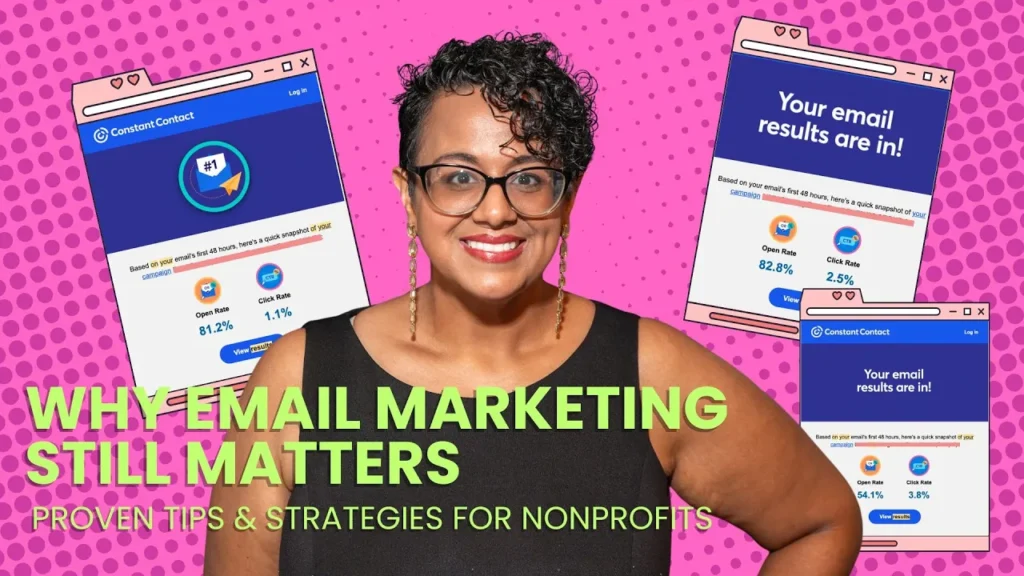
Across a few nonprofit campaigns I worked on between January and July, open rates ranged from 40% to as high as 97%. The average open rate across those emails was 51.84%, which is significantly higher than the nonprofit average.
Click-through rates averaged 1.4%, with some campaigns reaching as high as 6%. That means the average click-through rate in these campaigns was roughly 1300% higher than the nonprofit industry average.
Those results don’t happen by accident. They come from intentional strategy.
So today I want to share nine tips that you can start implementing right away to improve your email marketing results.
Tip 1: Dive into the data.
Start by looking at where you are right now. What is your open rate? What is your current click-through rate? You need to measure these things so you understand your starting point and can set goals for improvement.
Tip 2: Listen to your supporters.
Pay attention to what your audience responds to. Do they engage more with stories, numbers, or case studies? Give them more of what they want to hear and you’ll see better engagement.
Tip 3: Personalize your emails.
I’ve seen many nonprofits rely on one standard newsletter format with no personalization. People want to feel like they matter to your organization. Even something as simple as including their name in the subject line or message can make the email feel more personal.
Tip 4: Use tasteful visuals.
Visual elements help break up text and keep readers engaged. That doesn’t mean filling your email with pictures or emojis. The goal is balance — avoid both walls of images and walls of text. A few thoughtful visuals can make your message easier to read.
Tip 5: Tell a story.
There’s a saying in marketing: facts tell, but stories sell. In nonprofit work, storytelling helps people connect emotionally with your mission. Whether it’s an impact story, a case study, or a personal anecdote, stories help your message stick.
Tip 6: Keep it brief.
No one has time for extremely long emails. Focus on one main topic or story per email so your readers don’t feel overwhelmed.
Tip 7: Segment your audience.
Different groups of supporters should receive different messages. A new donor shouldn’t get the same email as a long-time monthly supporter. Segmenting your list allows you to tailor messages so they meet people where they are.
Tip 8: Work the data.
After you send an email, don’t just move on. Look at the results. Who opened it? Who clicked? Which links performed best? Use those insights to refine your strategy.
Tip 9: Pivot and adapt.
Email marketing isn’t “set it and forget it.” Look at your data regularly and be willing to change what isn’t working. One of my favorite reminders is simple: if you don’t like where you are, change it. You are not a tree.
The same idea applies to your email strategy.
I’ll quickly recap those tips: dive into the data, listen to your supporters, personalize your emails, use tasteful visuals, tell stories, keep emails focused, segment your audience, analyze your data, and be willing to pivot and adapt.
I hope this has been helpful.
At the end of the day, email is still an incredibly valuable communication tool. It’s direct and personal, and when used strategically it can create lasting connections with your audience.
It’s not just about broadcasting messages. It’s about building relationships — whether you’re working in nonprofits, public benefit corporations, or even for-profit organizations.
Successful organizations are the ones that learn how to build real connections with their communities, and email is one of the best ways to start doing that.
Use these tips to build a strategy that works for your organization.
And if you’re looking for guidance as you develop your communications strategy, feel free to reach out. I’d love to help you build thoughtful campaigns and strategic messaging that truly connect with the people you serve.
Alright, I hope you all have a wonderful rest of your day. Take care, and I’ll see you next time.
YouTube Publish Date: July 24, 2025
👉 https://youtu.be/yB25TOLhiYw

Did this resource help you strengthen your email strategy?
I create practical communications resources to help small businesses, nonprofits, and mission-driven leaders improve how they connect with their audiences — from email strategy to messaging, calls to action, and follow-through.
If these tips gave you something useful to apply, you can share this resource with someone who needs it or support future free resources by buying me a coffee.