
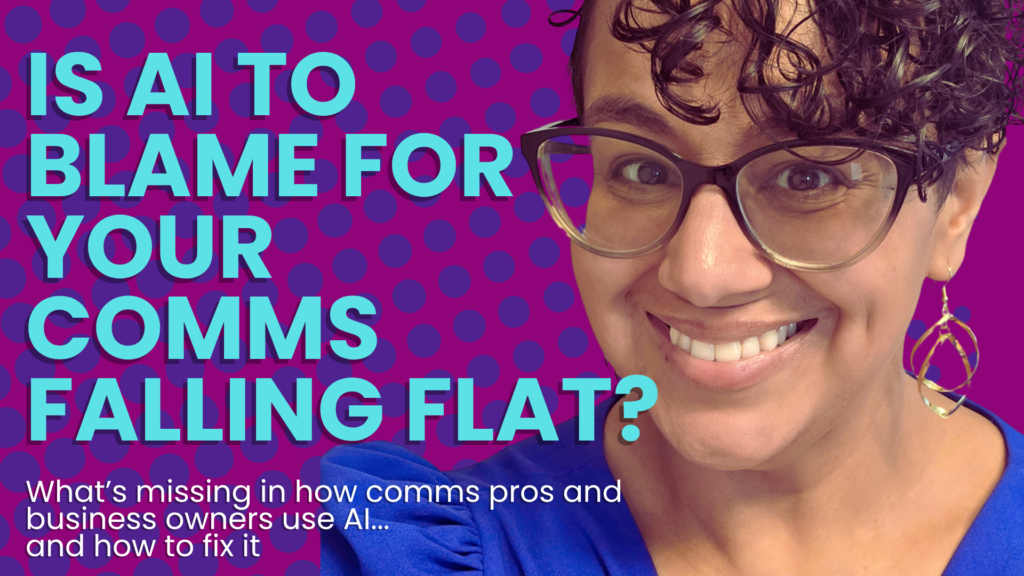
If you’ve recently found yourself asking questions like:
Why did that AI-written email have such a low open rate?
Why does our content feel off, even when we’re using the right tools?
Why isn’t AI actually saving us time the way we expected?
You’re not alone.
Over the past few years, I’ve been working with AI in a very practical way, starting in early adoption and more recently applying it within client environments.
In 2025, that included working alongside teams leading AI adaptation in healthcare marketing, supporting a six-month series of webinar-style trainings for industry professionals.
Alongside that work, I’ve continued learning in spaces focused on AI leadership and change management.
In a training I attended today, many of the same patterns came up that I hear from clients at the start of our work together.
Many organizations start with the same challenge: a lack of a clear AI communication strategy. They feel pressure to adopt AI quickly, but lack clarity on how it fits into their communication processes. The result is inconsistent output, mixed expectations, and a growing sense that something should be working better than it is.
At the same time, my perspective on this does not come from AI alone.
It comes from nearly two decades of working in communications, helping people understand how to connect across a wide range of environments. That includes front-line customer interactions, internal team communication, and digital platforms such as email, social media, and websites. Across all of that work, one principle has remained consistent. How something is communicated matters just as much as what is being said.
That foundation has made one pattern increasingly clear.
AI adoption is not breaking down because the technology is failing. It is breaking down because people do not know how to work with it together.
Looking Beyond the Tool:
AI Communication Strategy in Practice
Recent research reinforces what many teams are already experiencing.
Boston Consulting Group has reported that many organizations are still struggling to generate meaningful value from AI at scale. The issue is rarely the capability of the tools themselves. More often, it comes down to adoption, alignment, and integration.
According to McKinsey & Company, organizations continue to face gaps in readiness, particularly when it comes to skills, leadership direction, and clear communication about how AI should be used.
As highlighted by Harvard Business Review, transformation efforts often fall short when organizations underestimate the role of behavior change, internal communication, and culture.
Access to AI is no longer the primary barrier. The challenge is how it is being applied within real communication systems, often without a clearly defined AI communication strategy.
The Role of Brand Voice in AI Integration
Before AI can produce meaningful, aligned communication, it requires a clear understanding of how an organization sounds, communicates, and connects with its audience.
This is not a simple exercise.
Voice is not static. It shifts depending on context, whether an organization is communicating through email, social media, long-form content, or internal messaging. It reflects tone, values, audience expectations, and purpose.
In my work, this process often begins by helping organizations articulate and document their voice in a way that is both consistent and adaptable. This approach draws on years of lived communication experience, including executive ghostwriting, stakeholder messaging, and strategic content development.
Only after that foundation is established does AI become a useful extension of the system.
Without it, AI is left to interpret vague or incomplete direction, which leads to inconsistent outputs and additional manual correction.
Five Common Breakdowns in AI Adoption
While each organization is different, several patterns consistently emerge when AI adoption struggles.
1. The Fear Factor
Resistance to AI is often rooted in uncertainty rather than opposition. Employees may question how their roles will change or whether expectations are clearly defined. Without intentional communication, this uncertainty slows adoption.
2. The Skill Gap
Access to AI tools does not guarantee effective use. Many teams lack the training required to integrate AI into their workflows in a meaningful way, which leads to inconsistent use or underutilization.
3. The Leadership Lag
AI adoption often moves faster than leadership adaptation. When expectations, policies, and communication strategies are not updated accordingly, teams are left without clear direction.
4. The Silo Problem
In the absence of shared systems, individuals adopt AI independently. This creates inconsistency, limits collaboration, and introduces risks related to data use and messaging alignment.
5. The Strategy Disconnect
AI is often introduced as a shortcut rather than as part of a broader system. Without a clear strategy guiding its use, it becomes another tool layered onto already fragmented processes.
Where AI Use Begins to Break Down
Across organizations, these breakdowns tend to lead to similar outcomes.
Content is produced, but it lacks consistency. Messaging is technically correct, but it does not resonate. Communication efforts increase in volume, but not in impact.
This is where frustration begins.
AI is expected to improve communication, but without a clear foundation, it reflects the gaps that were already there. Rather than solving the problem, it makes it more visible.
At this point, many organizations misdiagnose the issue.
They assume the tool is not working, when in reality, the system surrounding the tool has not been fully developed.
Reframing the Role of AI in Communication
When used effectively, AI can support and extend strong communication systems. It can improve efficiency, assist with content development, and help teams scale their efforts more sustainably.
However, it does not replace the need for clarity, structure, or strategic direction.
The organizations seeing the most success are not those avoiding AI, nor those relying on it entirely. They are the ones integrating it into an existing framework of well-defined communication practices.
This includes documenting brand voice in a way that is actionable, aligning teams around shared messaging standards, and treating AI as a tool that requires guidance rather than as a solution that operates independently.
A Different Way to Think About It
At its best, AI is not a replacement for communication. It is a reflection of it.
It responds to the information it is given, the clarity of the input, and the consistency of the system behind it. When those elements are strong, the output improves. When they are not, the gaps become more visible.
In many ways, that creates an opportunity.
Because the same principles apply to us.
Effective communication has always required the ability to listen, to process information fully, and to respond with intention. It requires context, awareness, and a willingness to refine how we show up based on what we are learning.
Those are the same behaviors we expect from the tools we are using.
And yet, they are often overlooked when speed becomes the priority.
Where This Leaves Us
The goal is not to avoid AI. It is not to rely on it without question.
It is to use it well.
That means approaching AI as a system that reflects the clarity, consistency, and thoughtfulness behind it.
It also requires a shift in how we engage with information. Not just how we communicate outwardly, but how we receive, process, and refine what we are working with.
Because strong communication has never been about volume. It has always been about alignment.
And AI does not change that.
Sources & Further Reading
- Harvard Business Review: Overcoming the Organizational Barriers to AI Adoption
- Harvard Business Review: Where Senior Leaders Are Struggling with AI Adoption, According to Research
- McKinsey: Are your people ready for AI at scale?
- BCG: To Unlock the Full Value of AI, Invest in Your People
- BCG: AI Adoption Puzzle: Why Usage Is Up But Impact Is Not
- Debilee Flores: Why Your Business Needs a Communications Strategy
- Debilee Flores: Why Email Marketing Still Matters
Ready to build an AI Communications Strategy
that actually supports your business?
CLICK HERE TO GET STARTED!

Did this article help you think more clearly about AI and communications strategy?
I create free resources like this to help small businesses, nonprofits, and mission-driven leaders use tools like AI with more clarity, intention, and strategy — not just more noise.
If this gave you a helpful starting point, you can share it with someone who needs it or support future free resources by buying me a coffee.